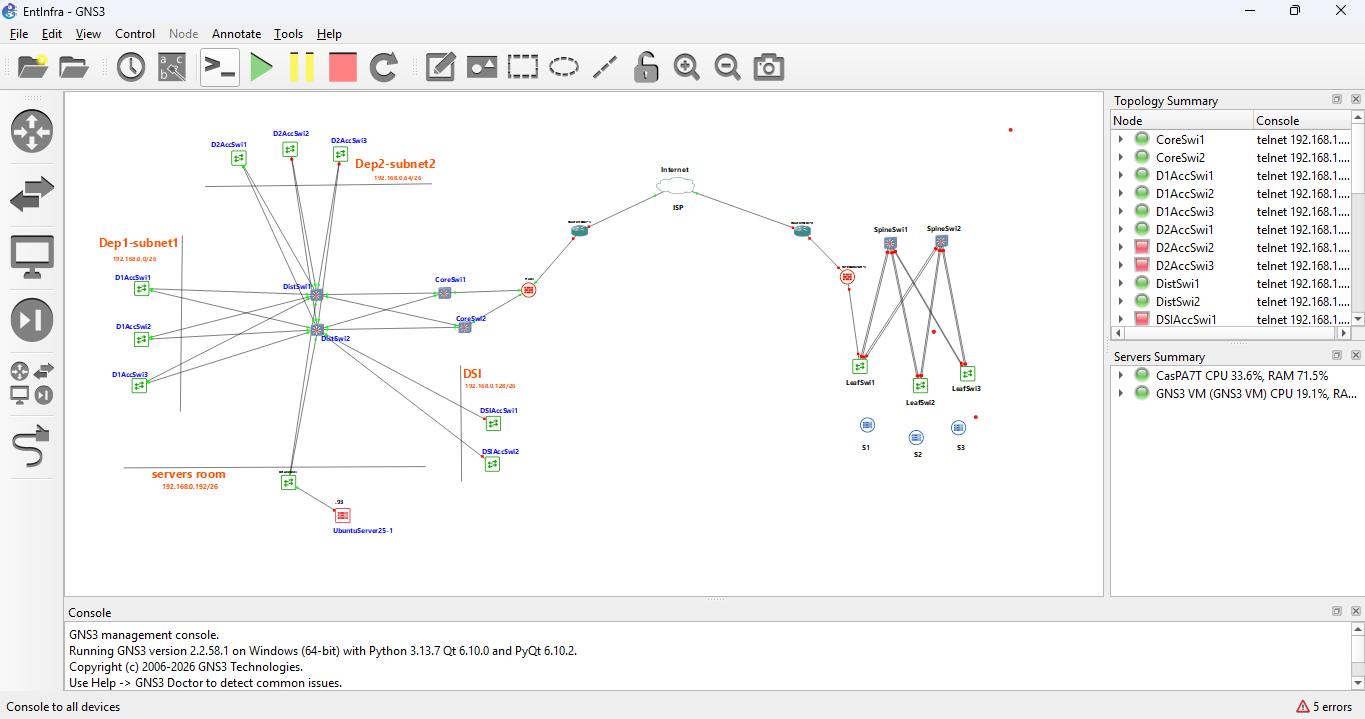
An end-to-end lab where I build a realistic enterprise infrastructure from the ground up rather than following a tutorial: two major estates — a three-tier enterprise network and a spine-leaf datacenter — wired in GNS3, with the server side providing the real services a company runs on. The goal is to practise the whole stack (routing, switching, automation, security and monitoring) the way it actually fits together in production.
- Primarily a skills-growth project: each component is chosen to deepen hands-on expertise, not just to tick a box.
- PacketFence is deployed to master an open-source, production-grade NAC (802.1X + captive portal) on a free stack.
- Zabbix is run to get real practice with infrastructure monitoring, alerting and dashboards.
- Everything is config-as-code: playbooks live in GitLab and are pushed and audited through Ansible/AWX for a desired-state network.
Architecture
Why these services — and what they teach me
- PacketFence (NAC) — Grow real skills on an open-source NAC: 802.1X, captive portal and dynamic access control without a vendor licence.
- Zabbix (monitoring) — Hands-on with metrics, triggers, alerting and dashboards across a multi-device estate.
- DHCP & DNS — Core network services — DHCP with relay across department subnets, internal DNS for forward/reverse name resolution.
- Apache / NGINX — Serve internal web apps and practise reverse-proxy / virtual-host configuration.
- Ansible AWX — Orchestrate config-as-code from a central UI with inventories, credentials and job templates.
- Internal PKI & NTP — Issue certificates for 802.1X/TLS and keep consistent time for logs, auth and monitoring.
Enterprise — three-tier network
Access, distribution and core layers with a dedicated subnet per department. Each configuration below is deployed and monitored by Ansible playbooks pulled from GitLab.
- Department subnets + inter-VLAN routing — Isolate each department and control traffic between them at the distribution layer.
- SSH + management IPs on every device — Required so Ansible/AWX can reach and configure the gear remotely — the foundation for automation.
- OSPF (internal routing) — Scalable, fast-converging dynamic routing inside the enterprise instead of static routes.
- OSPF ↔ BGP at the edge — Exchange routes with the outside (ISP/Internet) cleanly while keeping the internal IGP independent.
- Spanning Tree (STP/RSTP) — Keep a loop-free L2 topology while still cabling redundant links between switches.
- CDP (enterprise discovery) — Cisco neighbour discovery for topology mapping and automated inventory on the enterprise side.
- EtherChannel — Bundle parallel links between distribution and core for more bandwidth and link redundancy.
- HSRP — First-hop gateway redundancy so departments keep connectivity if a distribution switch fails.
Datacenter — spine-leaf fabric
A separate spine-leaf estate for predictable, scale-out east-west traffic.
- Spine-leaf topology — Equal-cost paths and consistent latency between any two leaves — the standard modern DC design.
- LLDP (datacenter discovery) — Vendor-neutral neighbour discovery, the right fit for a mixed/standards-based fabric.
Edge security
A FortiGate 7.6 NGFW sits at the enterprise edge, handling perimeter policy, NAT and segmentation between the inside, the DMZ/servers and the Internet.
Already running
- Ansible AWX installed and ready to orchestrate jobs.
- DHCP (with relay on the switches for the other subnets) and internal DNS (forward + reverse) in service.
- Network segmentation done — department subnets in place.
- SSH and management IPs configured on the enterprise network devices.
- FortiGate NGFW 7.6 installed and configured (basic policy) at the enterprise edge.
Coming soon
- PacketFence NAC — 802.1X and captive portal rollout.
- OSPF + BGP routing deployed across the estate via Ansible.
- STP, CDP/LLDP, EtherChannel and HSRP pushed and audited by playbooks.
- Apache / NGINX internal web services.
- Zabbix monitoring and alerting.
- Active Directory / LDAP for centralized identity and authentication.
- Internal PKI / Certificate Authority for EAP-TLS and internal TLS.
- NTP server for estate-wide time synchronization.
- Centralized logging & SIEM (Syslog / ELK) for audit and correlation.
- Backup & restore for device configs and servers.
- SMTP relay for system and alerting notifications.
- File & print services (Samba / NFS) for the departments.
- Web proxy & content filtering for outbound traffic.
- Datacenter spine-leaf build-out and routing.
- Compliance and drift-remediation playbooks.